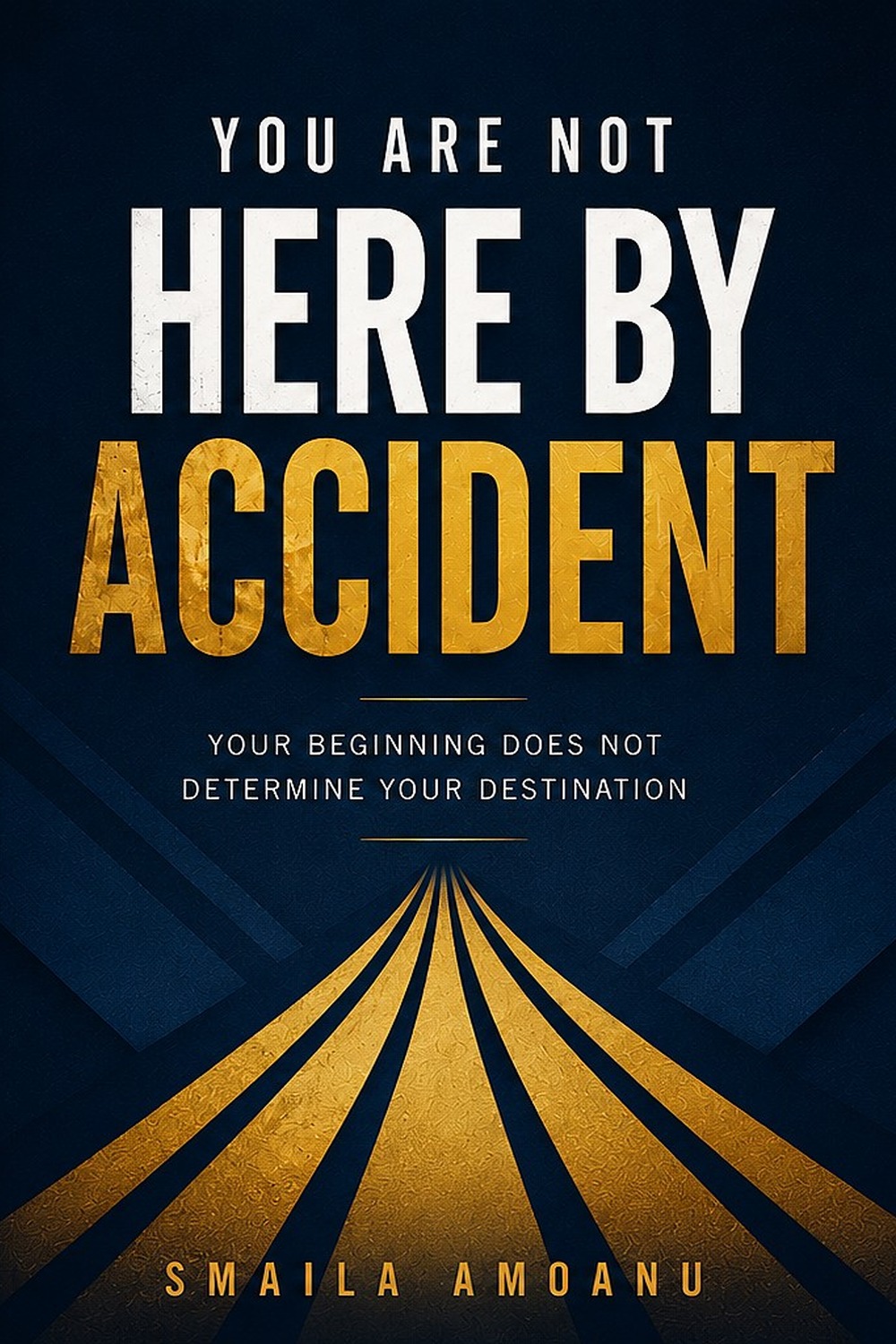
Smaila Amoanu
Your Beginning Does Not Determine Your Destination
Some people never start because they are waiting for certainty. Others never finish because they are waiting for perfection. This book dismantles both traps from the inside out.
"There is a moment most people never talk about. It arrives in an ordinary day, a question surfacing that you have been outrunning for longer than you realise. Is this it? That question is the reason this book exists."
What This Book Confronts
Chapter One
The prosecutor has gathered real evidence from your life. The facts are real. Nobody is disputing the facts. But the conclusion the prosecution is drawing was never his to write. Jeremiah 1:5 said it before the evidence existed.
Chapter Two
There is a scarecrow in the field. It has no power. But it has convinced entire harvests to stay away. This chapter names the stronghold and removes its authority over your interior life.
Chapter Three
The Certainty Trap. The Perfection Trap. Do It Afraid. None of the platforms that changed the world launched perfect. The version you are waiting to release is already overdue.
Chapter Seven
What looks like a closed door from the front is often an open corridor from inside. Two failures are not a verdict. The author writes from experience, and from the evidence of what followed.
Chapter Eight
The appointed time. Habakkuk 2:3. Joseph did not waste his years in Egypt: he was being built for what Egypt could not contain. Your season of waiting is not punishment. It is preparation.
A Final Challenge
The book does not end with a conclusion. It ends with an assignment. Seven days. Seven decisions. The kind nobody else sees you make, and everything gets built on top of.
"The most important decision you will ever make is the one nobody else sees you make."
You Are Not Here by Accident, Introduction
Who This Book Is For
Prologue and Introduction setting up the argument of the book. Twelve chapters moving from the lie about your starting point to the appointed time and everything in between. A Final Challenge, the Seven-Day Challenge. A Group Discussion Guide designed for youth groups, churches, and small fellowships. Reflection prompts throughout. Instant PDF download, A5 format, professionally typeset.
Opening Pages
The Prologue and Introduction are below, the real opening of the book, word for word. If it lands, get the full copy.
Prologue
There is a moment most people never talk about.
It arrives quietly, not in a crisis, not in a collapse, but in an ordinary day. You are doing what the day requires. Going where you need to go. Showing up where you are supposed to be. And somewhere in the middle of all that motion, a question surfaces that you have been outrunning for longer than you realise.
Is this it?
Not spoken aloud. Never spoken aloud. Just present, beneath the tasks, beneath the routine, beneath the version of yourself that you present to the world without thinking about it anymore.
It is not a question about whether things could be worse. You know they could be. It is a question about whether the life you privately sense you were made for, the one that occasionally surfaces in quiet moments before the noise begins, is something you are actually allowed to reach for.
That question is the reason this book exists.
You are not here by accident. Whatever brought this book into your hands today, none of it is random. And the distance between where you are and the life you were made for is not what it looks like from here.
Introduction: The Decision Nobody Saw
I want to tell you about a morning.
I cannot give you the exact date because there was no exact date. It was ordinary in every visible way. But somewhere inside that ordinary morning, I made a decision.
The voice that speaks in those circumstances is patient and consistent. It does not shout. It simply repeats, in the language of evidence: people from places like this do not end up in places like that. And the sooner you make peace with that, the better.
I had been listening to that voice for long enough that it had stopped feeling like a voice and started feeling like the truth.
And then, on that ordinary morning, something in me said no. Not loudly. Not dramatically. Just no. A quiet, private, witnessed-by-nobody refusal to let that voice have the final word.
The most important decision you will ever make is the one nobody else sees you make.
Chapter One: The Lie About Your Starting Point
There is a verdict that gets delivered early.
Not always in words. Sometimes in the way a room falls silent when you speak. Sometimes in the opportunities that seem to go to everyone except you. Sometimes in the cumulative weight of a hundred small moments that all pointed in the same direction, telling you, quietly but consistently, that where you started has already decided where you will end.
Most people receive this verdict before they are old enough to question it. It arrives in the voice of a parent who expected less. In the assessment of a teacher who had already decided what kind of future belonged to a person from a background like yours. In the neighbourhood, the circumstances of your birth that nobody consulted you about before assigning them to you.
And because the verdict arrives early, before you have the language to challenge it, before you have the evidence to contradict it, it tends to go in deep. It stops feeling like something that was said to you and starts feeling like something that is simply true about you.
That is the lie this chapter is about. Not a small misunderstanding. Not a minor distortion. A lie, specific, deliberate, ancient, and wrong, that has done more damage to more human lives than almost any other force on earth.
The lie says this: your beginning has already written your ending.
Think about how a courtroom works. A prosecutor gathers evidence. Facts. Real, verifiable, undeniable facts. Nobody in the courtroom disputes that the facts are facts. The neighbourhood is real. The circumstances are real. The failures on record are real. The prosecutor stands before the jury and presents all of it, systematically, compellingly, in the order most likely to produce the conclusion the prosecution wants.
The conclusion comes first. The verdict was decided before the evidence was gathered. The evidence was then selected, curated, arranged, presented, to support a conclusion that already existed. This is not the same thing as finding the truth. This is building a case.
The voice is a prosecutor. It gathers real evidence from your life. The facts are real. Nobody is disputing the facts. What the prosecution is doing with the facts, using them to build a case for a conclusion that was decided before you were born, that is where the argument collapses.
Because here is what the prosecutor does not tell you. The conclusion about your life was not written by the prosecution. It was written by the Judge, before the trial began. Before the evidence existed. Before you arrived to provide any facts that could be used for or against you.
Jeremiah 1:5: Before I formed you in the womb I knew you. Before you were born I set you apart.
Before. Before the starting point was assigned. Before the circumstances accumulated. Before the failures went on record. Before the prosecution had a single exhibit to present. The verdict about your life was delivered before the prosecutor had any evidence to work with. Which means the case the prosecution is building, however real the facts, is arguing against a conclusion that a higher authority already settled.
Your starting point is not a sentence. It is a location. A sentence is final. A location is simply where you are standing right now, and where you are standing right now has nothing to do with where you are capable of walking to. And the One who decided where your journey ends was not consulting your starting point when He decided it.
God has a habit of choosing the wrong people. The shepherd boy when there were stronger brothers available. The stuttering man when there were eloquent men available. The youngest son when there were older ones. The fishermen when there were scholars. Again and again, God chooses the person whose starting point gives the world no obvious reason to expect anything significant. And again and again, that person goes on to do something that the starting point had no business producing.
Your starting point does not have access to what God put in you. It can obscure it. It can delay it. It cannot destroy it.
The preview ends here. Chapter One continues with the call to refuse the prosecution's verdict, and the remaining eleven chapters follow.
eBook PDF
Instant download. Read on any device.
eBook PDF, A5 format, instant download
Secure checkout via Payhip. Instant delivery to your inbox.